
Restore & Recover
Supports recovery and tissue resilience.
BPC-157 + TB-500Optional: NAD+
Peptide therapy
A synthetic fragment of thymosin beta-4 studied in animal injury models for cell migration and tissue repair. Human RCT data is absent.
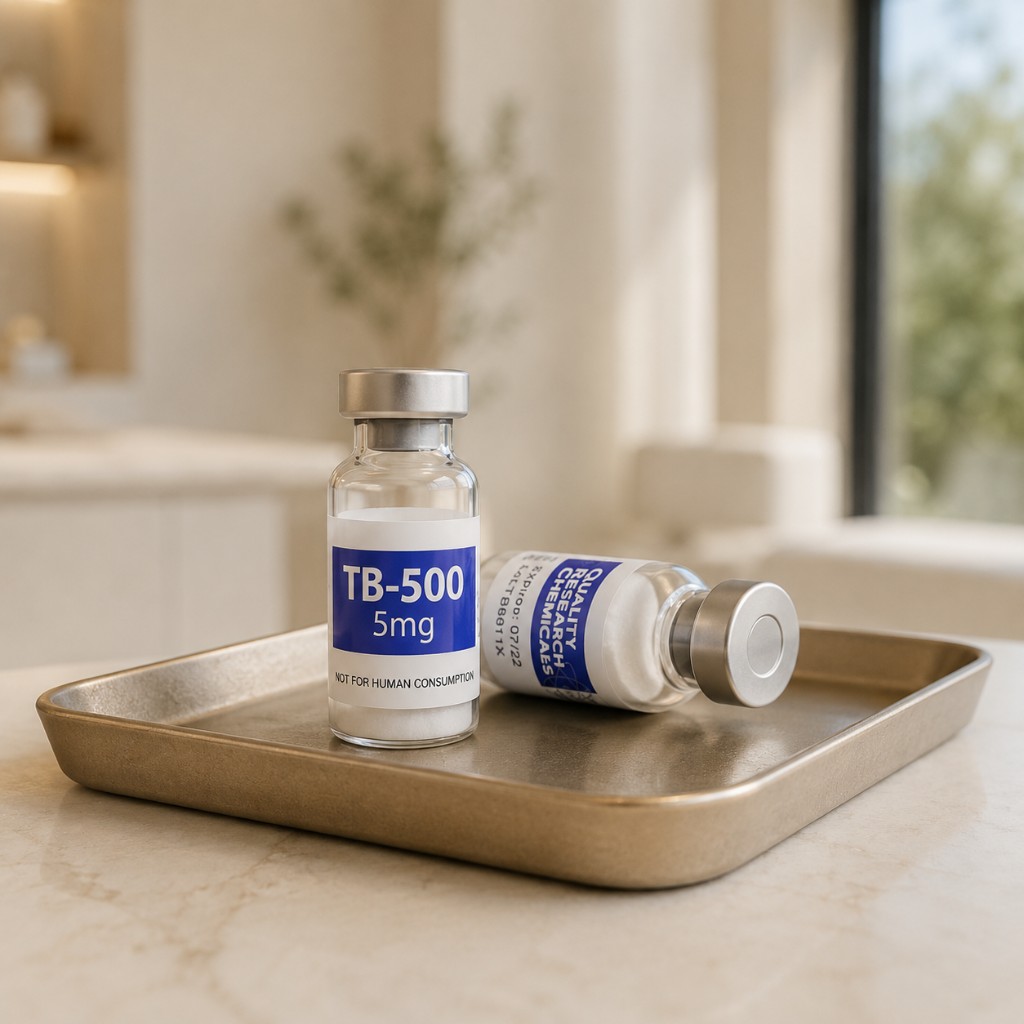
TB-500 is a synthetic fragment of thymosin beta-4, a naturally occurring protein involved in cell migration and tissue repair. It is widely discussed in recovery contexts, but the human evidence base is essentially zero. Animal data is suggestive. Human RCTs do not exist.
This page explains what TB-500 is, what the preclinical research shows, what FDA's current regulatory position looks like, and how Genesis Longevity frames its responsible use.
What it is
TB-500 is a synthetic fragment of thymosin beta-4, a 43-amino-acid protein involved in cell migration and tissue repair that occurs naturally in nearly all human and animal cells. TB-500 itself is the active fragment researchers have isolated for study.
It is described as a research compound because no pharmaceutical company has completed the large-scale, placebo-controlled human trials required for FDA drug approval. This is not because it is known to be ineffective. The economics of peptide development (low cost to synthesize, limited patent protection) do not justify the investment a New Drug Application requires.
TB-500 is available in the United States only through 503A compounding pharmacies with a valid provider prescription. That availability is subject to ongoing FDA regulatory action. The FDA Pharmacy Compounding Advisory Committee (PCAC) reviewed both BPC-157 and TB-500 at its July 2026 meeting for potential 503A list inclusion.
How it works
Mechanisms below derive from preclinical models, cell cultures and rodents primarily. Human mechanistic studies confirming these pathways at compounded injectable doses do not exist.
Whether animal-model biology translates to meaningful clinical outcomes in humans is the central unanswered question.
Conditions and use cases
Because human RCT evidence is absent for musculoskeletal use, Genesis Longevity offers TB-500 under strict informed consent acknowledging the experimental nature of the therapy. Patients presenting for TB-500 commonly have:
TB-500 is not appropriate as a first-line or substitute-for-surgery therapy. The patient should have a documented injury with prior conservative management and understand the experimental status.
Expected timeline
Week 0 to 2
Initiation phase
Anecdotal compounded protocols use loading frequency in the first 1 to 2 weeks. Patients commonly report reduced pain or stiffness in this window in animal-model timeframes.
Week 2 to 4
Early response window
Anecdotal reports describe perceived mobility improvement. No human RCT defines an expected delta. Provider monitors injection site tolerance.
Month 1 to 3
Cycle continuation
Typical anecdotal cycles run 8 to 12 weeks. Provider re-evaluates against patient-reported outcomes and any concurrent imaging or strength testing.
Month 3 to 6
Cycle review
Long-term safety beyond approximately 12 weeks is unknown in humans. Decisions about continued use are individualized.
Stacks that include this
Supports recovery and tissue resilience.
Cellular support for skin radiance and tone.
Investment and access
Genesis Longevity therapies are dispensed only after a complimentary consultation and Good Faith Exam. Schedule yours to receive a personalized plan.
Safety
Reported anecdotally and in the limited human data:
Absolute contraindications.
Relative contraindications requiring shared decision-making.
Frequently asked
No. TB-500 is a research peptide, not FDA-approved. The FDA Pharmacy Compounding Advisory Committee (PCAC) reviewed it at its July 2026 meeting for potential 503A list inclusion. Regulatory status is in active flux.
There are zero human clinical trials of TB-500. Reports of healing from athletes and patients represent anecdotal experience, subject to placebo effect, natural healing trajectories, and selection bias. Animal studies are encouraging. Human evidence is not yet there.
Standard 5- or 10-panel employment drug tests do not detect peptides. Sport-specific testing (Olympics, professional leagues, military special operations, USADA/WADA testing) does detect TB-500.
The theoretical complementarity is that BPC-157 targets local tissue healing while TB-500 focuses on systemic cell migration and stem cell mobilization. There are no controlled human studies of the combination. The reasoning is physiologically plausible but unproven.
Genesis Longevity strongly recommends against this. Online research-peptide vendors operate outside pharmaceutical regulation and provide no quality assurance, no provider monitoring, and no certificate-of-analysis verification.
Sources
Status & disclosures
Next step
Schedule a consultation. Physician-led, evidence-graded.
Or keep reading: Or browse the Restore & Recover stack